



Electrical Power and Energy
Power and energy are two closely related quantities that every electronics engineer and radio operator must understand. Power tells you how fast energy is being used or converted. Energy tells you the total amount used over a period of time. Knowing how to calculate power lets you choose the right components, design safe circuits and understand why equipment gets hot.
What Is Power
Power is the rate at which energy is converted from one form to another. It answers the question: how fast is energy being used right now? The symbol for power is P and the unit is the watt (W), named after Scottish engineer James Watt.
Consider the light bulb in your shack. If it is rated at 60 W, it converts 60 joules of electrical energy into heat and light every single second. Your 100 W transceiver on transmit converts 100 W of DC input power into approximately 50 W of RF output power plus 50 W of waste heat — every second while you are transmitting.
A useful analogy: power is to energy what speed is to distance. Speed tells you how fast you are moving at any instant. Power tells you how fast energy is being used at any instant. Just as driving faster gets you to your destination sooner, a higher-power device uses up a given amount of stored energy more quickly.
What Is Energy
Energy is the total amount of work done or heat produced over a period of time. It is calculated by multiplying power by time:
Where E is energy, P is power in watts, and t is time.
The units depend on what unit of time you use:
- If P is in watts and t is in seconds, E is in joules (J).
- If P is in watts and t is in hours, E is in watt-hours (Wh).
- 1 kilowatt-hour (kWh) = 1000 Wh. Your electricity bill charges you per kWh.
A 100 W transceiver running continuously for 1 hour uses 100 Wh = 0.1 kWh. For portable operation, energy budgeting is critical: a 5 W QRP station running for a 10-hour SOTA activation uses 50 Wh. If your battery holds 100 Wh, you have approximately 20 hours of operating time at that power level — a simple calculation that could be the difference between finishing the activation and going silent on a hillside.
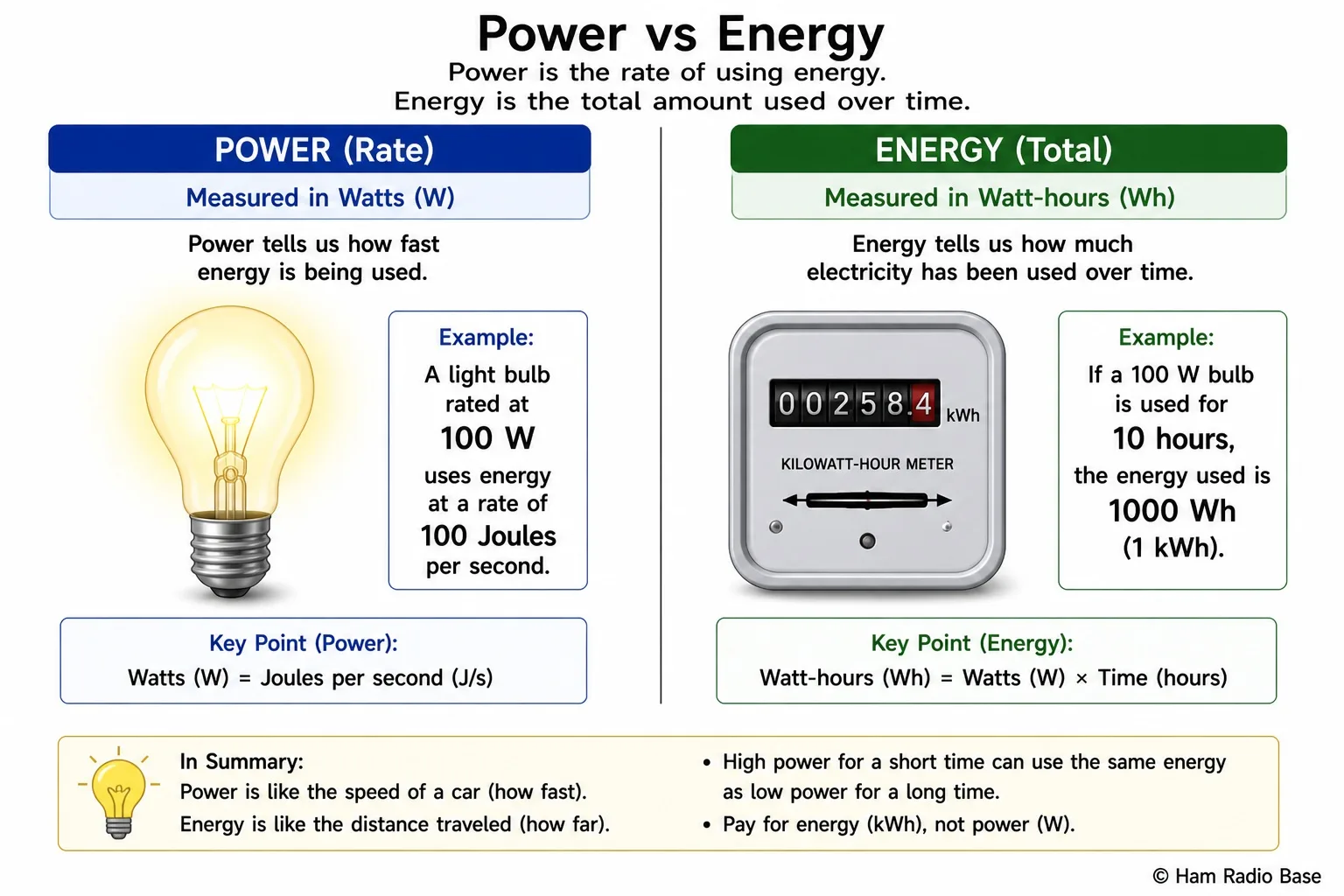
Power is the instantaneous rate of energy use. Energy is the accumulated total over time.
The Three Power Formulas
The fundamental power formula is P = V × I. By combining this with Ohm's Law (V = I × R), two further forms can be derived that are enormously useful when only two of the three quantities (voltage, current, resistance) are known.
- P = V × I — use when you know voltage and current (most direct)
- P = I² × R — use when you know current and resistance
- P = V² / R — use when you know voltage and resistance
P = V × I
This is the most direct form. If 13.8 V is applied to a load drawing 5 A, the power dissipated is P = 13.8 × 5 = 69 W.
P = I² × R
This form is especially important for resistors and wiring. Notice that power depends on the square of the current. Doubling the current through a resistor quadruples the power it must dissipate. A 100 Ω resistor carrying 100 mA (0.1 A): P = 0.1² × 100 = 0.01 × 100 = 1 W. The same resistor at 200 mA dissipates 4 W — this is why current limits matter so much in circuit design.
P = V² / R
Useful when the voltage across a component is known but not the current. A 50 Ω dummy load with 100 V RF across it: P = 100² / 50 = 10000 / 50 = 200 W.
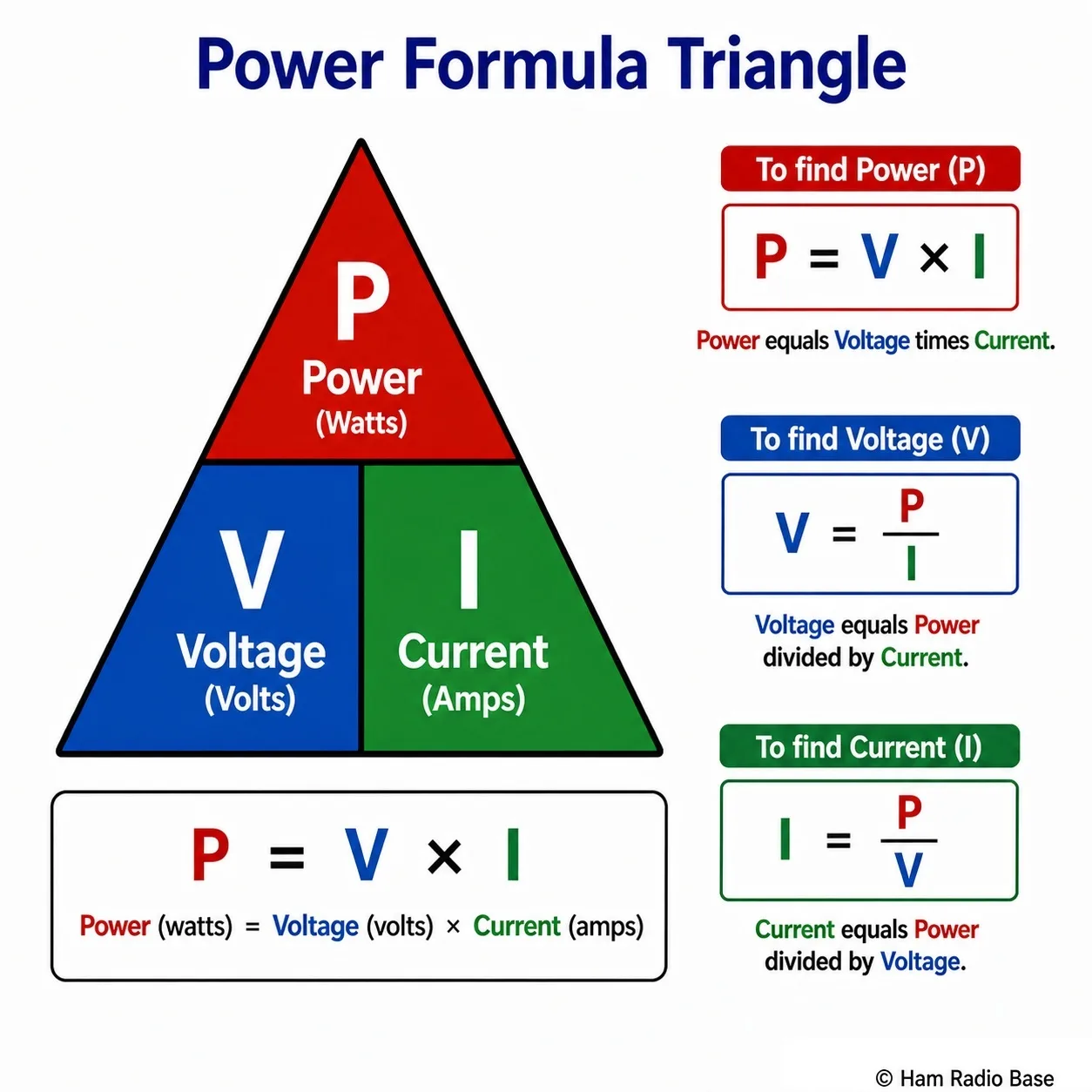
The power formula triangle: cover the quantity you want to find and read off the formula from the remaining two.
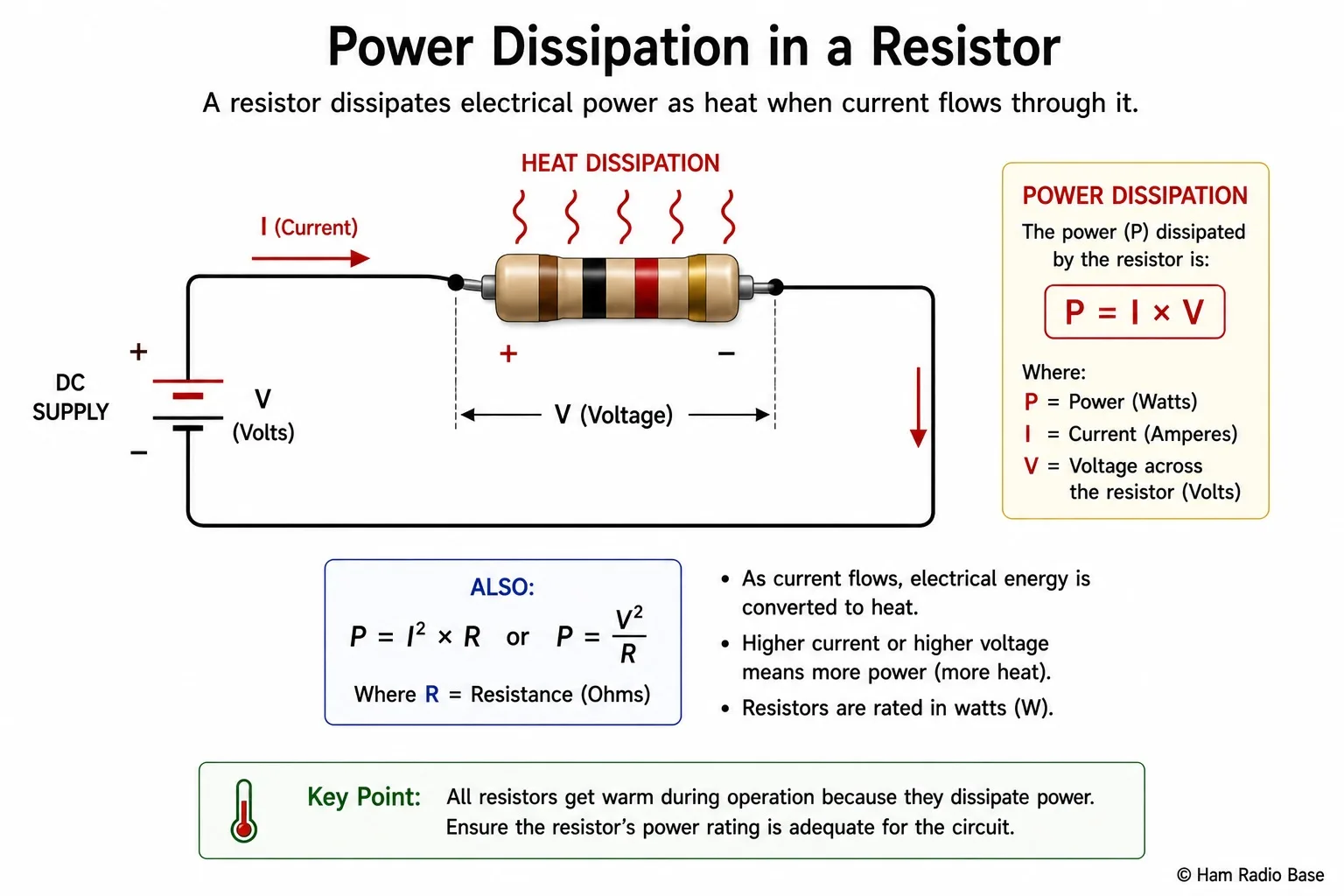
Power dissipation in a resistor: all electrical energy is converted to heat at a rate of P = I²R watts.
Power Calculator
Power, Voltage, Current and Resistance Calculator
Enter any two known values and click Calculate to find the remaining quantities. Uses P = V×I, P = I²×R, and P = V²/R.
Component Power Ratings
Every resistor, transistor and integrated circuit has a maximum power rating — the highest rate at which it can safely dissipate energy without overheating. Exceed this rating and the component will overheat and fail, sometimes immediately and sometimes after a period of thermal stress.
Standard resistor power ratings are:
| Rating | Common Use |
|---|---|
| 0.125 W (⅛W) | Small signal circuits, logic pull-up/pull-down resistors |
| 0.25 W (¼W) | Most common general-purpose resistor |
| 0.5 W | Moderate signal levels, bias networks |
| 1 W | Higher current paths, emitter resistors in power stages |
| 2 W | Power dissipation in audio and RF circuits |
| 5 W | Heavier current limiting and load resistors |
| 10 W | Dummy loads, braking resistors, high-power circuits |
Always calculate the power before selecting a component. For a 100 Ω resistor with 100 mA through it:
A 1 W rated resistor is exactly at its limit. Apply the 50% derating rule and you need a 2 W rated resistor.
Ham Radio Power Examples
1. Power Supply Sizing
You want to run a 100 W HF transceiver from a regulated 13.8 V supply. The radio's power amplifier stage is about 50% efficient — it produces 100 W of RF but requires approximately 200 W of DC input power to do so.
Add at least 20% headroom for inrush current spikes and supply regulation under load:
14.5 × 1.2 = 17.4 A → choose a supply rated for at least 20 A.
Under-sizing the supply causes the output voltage to sag under transmit load, which reduces TX power, stresses the supply and can cause audio distortion on received signals.
2. Resistor Power Check
Returning to the fan resistor example from the Ohm's Law lesson: a 35 Ω series resistor with 0.2 A flowing through it.
A standard ¼ W resistor would immediately fail. A ½ W or 1 W resistor would be marginal.
Correct choice: a 2 W or 3 W rated resistor.
3. Dummy Load Design
You want a 50 Ω dummy load for 100 W continuous use during contest operation (long key-down periods). You need to dissipate the full 100 W reliably.
Any single resistor used must be rated for 100 W continuous, or you can use multiple smaller resistors in parallel — four 200 Ω 25 W resistors in parallel give 50 Ω and 100 W combined capacity.
For contest use, oil-cooled enclosures or forced-air cooling are preferred over convection-only designs.
Frequently Asked Questions
What is the difference between power and energy?
Power (measured in watts) is the rate at which energy is used or converted — it is an instantaneous quantity. Energy (measured in joules or watt-hours) is the accumulated total — it is power multiplied by time. A 1000 W kettle has ten times the power of a 100 W lamp, but if the lamp runs for 10 hours and the kettle runs for 1 minute, the lamp uses far more energy (1000 Wh vs about 16.7 Wh). When sizing a battery, you care about energy (how many watt-hours are stored). When sizing a regulator or cable, you care about power (how many watts at any instant).
Why do resistors get hot?
When current passes through a resistor, free electrons repeatedly collide with the atoms of the resistor material. Each collision transfers kinetic energy to the atom, causing it to vibrate more. This increased atomic vibration is heat. The rate at which energy is converted to heat is exactly P = I²R (or P = V²/R). There is no way to have current through a resistor without some heat being produced — the only way to reduce heating is to reduce the current, the voltage or the resistance value. This is why power dissipation calculations are essential before selecting a component.
What is efficiency and why does it matter?
Efficiency (η) is the ratio of useful output power to total input power: η = Pout / Pin. An amplifier with 60% efficiency that produces 100 W of RF output takes 100 / 0.6 ≈ 167 W from the supply. The remaining 67 W is wasted as heat. Efficiency matters for two reasons: first, the wasted power must be handled (heat sink design, airflow); second, in battery-powered portable operation, low efficiency means shorter battery life. Class A amplifiers have efficiencies around 25–30%. Class AB (most HF transceivers) achieve 40–60%. Class D and E switching amplifiers can reach 80–90%.
How do I size a fuse for my transceiver?
Calculate the maximum current the transceiver will draw during transmit (the highest current mode). Use I = P / V where P is the input power (output power divided by efficiency) and V is the supply voltage. Add 20–25% headroom for inrush current and component variation, then select the next standard fuse size above that value. For example, a 100 W HF radio at 50% efficiency: input power = 200 W, supply = 13.8 V, current = 14.5 A. With 20% headroom: 17.4 A. Use a 20 A fuse. Fuses protect wiring, not equipment — always fuse as close to the power source as possible.
Test Your Knowledge
Answer the questions below to check your understanding. Every answer can be found in the lesson above.