




Bandwidth of Each Mode
Radio spectrum is finite. Every mode you transmit with must fit inside an allocated channel, and the regulator defines what "fit" means in terms of occupied bandwidth. Understanding bandwidth — not just memorizing numbers but being able to calculate bandwidth from mode parameters — lets you predict whether a signal will cause interference, select the right IF filter for a receiver, understand why some modes fit more contacts into a given piece of spectrum than others, and pass the amateur licensing exam questions that test exactly these calculations. This lesson derives bandwidth formulas for each major mode from first principles and then tabulates the results for quick reference.
Bandwidth Definitions
Several bandwidth definitions are used in radio engineering, and confusing them leads to errors:
- Necessary bandwidth (Bn) — the minimum bandwidth required to transmit the information at the required quality. Defined by ITU-R and used in spectrum allocation planning. For voice modes this is typically the audio bandwidth times 2 (for DSB) or audio bandwidth (for SSB).
- Occupied bandwidth (Bocc) — the bandwidth containing 99% (or sometimes 98%) of total radiated power. This is what a spectrum analyzer measures in "occupied bandwidth" mode.
- −3 dB bandwidth (B3) — the bandwidth between the half-power (−3 dB) points of a signal or filter. Used for filter characterization.
- −60 dB bandwidth — used for shape factor (selectivity) calculations of IF filters: shape factor = B−60dB / B−3dB. A perfect rectangular filter has a shape factor of 1.
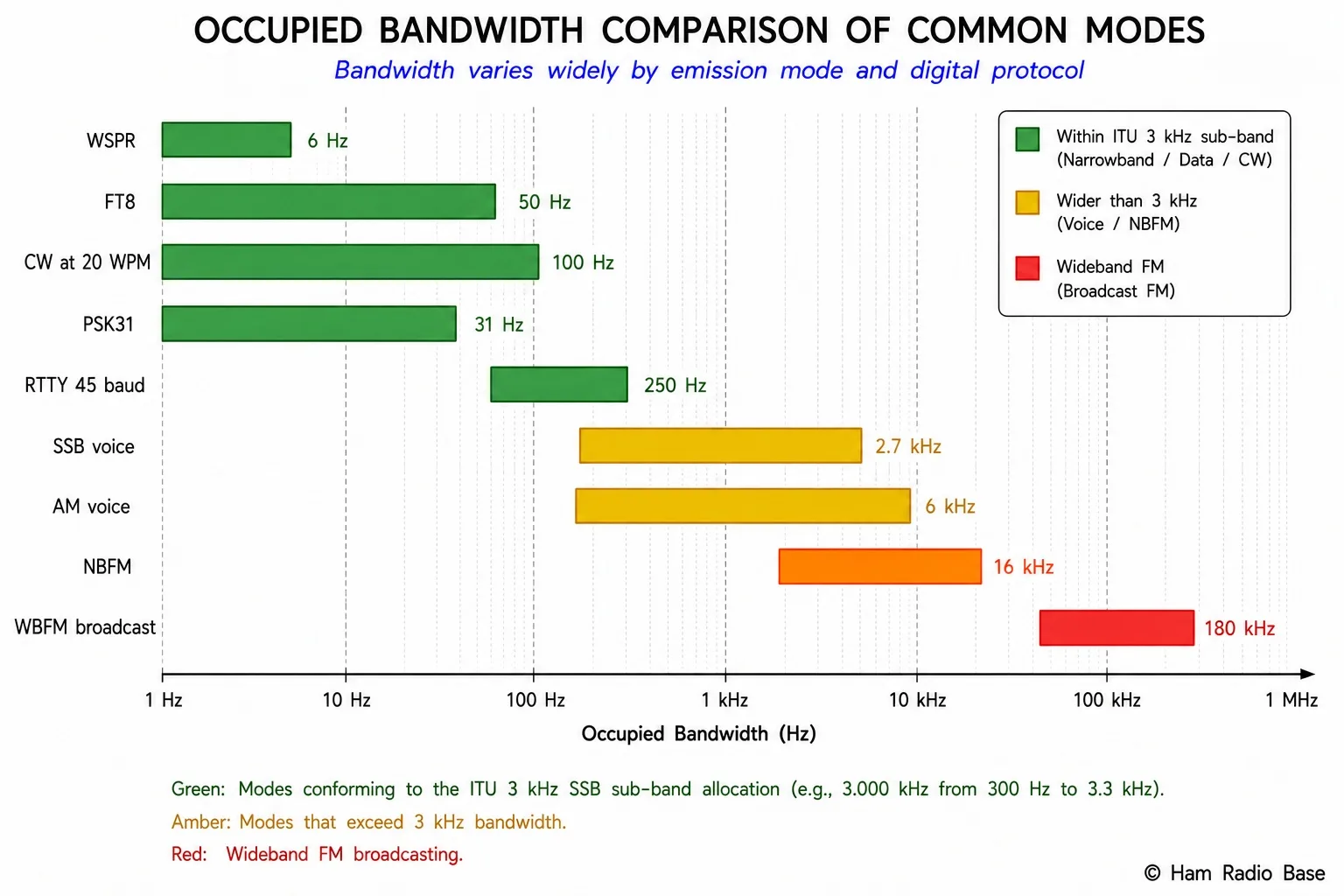
AM Bandwidth
Standard AM (DSB-FC — double-sideband full-carrier) produces two sidebands symmetrically around the carrier, each equal in bandwidth to the highest audio frequency. The total bandwidth is therefore twice the audio bandwidth:
BWAM = 2 × faudio,max
Voice AM (300–3,000 Hz audio): BW = 2 × 3,000 = 6,000 Hz (6 kHz)
Broadcast AM (50–10,000 Hz audio): BW = 2 × 10,000 = 20,000 Hz (20 kHz)
Aviation VOLMET (300–2,500 Hz audio): BW = 2 × 2,500 = 5,000 Hz (5 kHz)
An AM station transmits voice with audio up to 3.5 kHz.
BW = 2 × 3,500 = 7,000 Hz = 7 kHz
The upper sideband extends from fc to fc + 3.5 kHz; the lower sideband from fc − 3.5 kHz to fc.
SSB and DSB-SC Bandwidth
Single-sideband (SSB) transmits only one sideband — the upper (USB) or lower (LSB). The bandwidth equals the audio bandwidth alone, not twice it:
BWSSB = faudio,max − faudio,min
Voice SSB (300–3,000 Hz audio): BW = 3,000 − 300 = 2,700 Hz (2.7 kHz)
This is why SSB is exactly half the bandwidth of AM for the same audio content.
Double-sideband suppressed-carrier (DSB-SC) transmits both sidebands but no carrier, so its bandwidth equals AM bandwidth: BWDSB-SC = 2 × faudio,max. DSB-SC is used internally in SSB transmitter circuits before one sideband is filtered out, and in stereo FM pilots. On its own, DSB-SC has the same bandwidth as AM but is 6 dB more power-efficient (no carrier waste).
FM Bandwidth (Carson's Rule)
FM bandwidth depends on both the peak frequency deviation and the maximum audio frequency. Carson's rule provides the engineering approximation containing 98% of total power:
BWFM = 2 × (Δf + fm,max)
where Δf = peak frequency deviation, fm,max = highest audio frequency
This can also be written: BWFM = 2 × fm,max × (β + 1)
where β = Δf / fm,max is the deviation ratio
BW = 2 × (5,000 + 3,000) = 2 × 8,000 = 16,000 Hz (16 kHz)
WBFM (broadcast, 75 kHz deviation, 15 kHz audio):
BW = 2 × (75,000 + 15,000) = 2 × 90,000 = 180,000 Hz (180 kHz)
(Broadcast FM channels are spaced 200 kHz apart to accommodate this plus guard bands.)
NBFM (public safety, 2.5 kHz deviation, 3 kHz audio):
BW = 2 × (2,500 + 3,000) = 2 × 5,500 = 11,000 Hz (11 kHz)
Notice that NBFM amateur uses 16 kHz — nearly six times the bandwidth of SSB for similar voice quality. This is the fundamental reason SSB dominates HF amateur communication where spectrum efficiency matters, while FM is used on VHF/UHF where spectrum is more plentiful and the simplicity of FM transceivers is valued.
CW Bandwidth
CW bandwidth depends on keying speed (in words per minute, WPM) and the rise/fall time shaping of the keying transitions:
BWCW ≈ 5 × WPM (Hz) for properly shaped keying
At 25 WPM: BW ≈ 5 × 25 = 125 Hz
At 40 WPM: BW ≈ 5 × 40 = 200 Hz
At 5 WPM: BW ≈ 5 × 5 = 25 Hz
CW is extraordinarily spectrum-efficient — at 25 WPM it uses less than 5% of the bandwidth of SSB voice. This is why CW sub-bands can pack many simultaneous contacts into the same spectrum that would hold a single SSB signal.
Digital Mode Bandwidth
For digital modes, the occupied bandwidth is determined by the symbol rate (Baud) and the pulse shaping applied to the transitions. The Nyquist bandwidth theorem states that the minimum bandwidth required to transmit symbols at rate fs Baud without inter-symbol interference is fs/2 Hz (one-sided) or fs Hz (double-sided, as usually measured):
BWNyquist = fs (Baud)
With raised-cosine pulse shaping (rolloff factor α):
BW = fs × (1 + α)
where α = 0 gives minimum Nyquist bandwidth, α = 1 gives 2× Nyquist bandwidth
| Mode | Modulation | Symbol Rate | Bits/Symbol | Bit Rate | Approx. BW |
|---|---|---|---|---|---|
| PSK31 | DBPSK | 31.25 Baud | 1 | 31.25 bit/s | 31 Hz |
| FT8 | 8-GFSK | 6.25 Baud | 3 | 18.75 bit/s (net: 13 bit/s after FEC) | 50 Hz |
| RTTY | 2-FSK | 45.45 Baud | 1 | 45.45 bit/s | ≈250 Hz |
| Winlink Vara HF | OFDM/PSK | Variable | Variable | Up to 8,500 bit/s | 2.4 kHz |
| D-STAR (voice) | GMSK | 4,800 Baud | 1 | 4,800 bit/s | 6.25 kHz |
| DMR (voice) | 4-FSK | 9,600 Baud | 2 | 9,600 bit/s raw | 12.5 kHz |
| AX.25 1200 Bd | AFSK | 1,200 Baud | 1 | 1,200 bit/s | ≈3 kHz |
Full Mode Comparison Table
| Mode | Typical Bandwidth | Formula / Rule | Notes |
|---|---|---|---|
| CW (25 WPM) | 125 Hz | BW ≈ 5 × WPM | Narrowest practical voice-equivalent mode |
| PSK31 | 31 Hz | BW ≈ symbol rate (Baud) | Narrowest HF digital keyboard mode |
| FT8 | 50 Hz | 8-tone GFSK, 6.25 Baud | Designed for near-threshold propagation |
| RTTY | 250–300 Hz | BW = 2(Δf + fs) | 170 Hz shift, 45.45 Baud |
| SSB voice | 2.7 kHz | BW = faudio,max − faudio,min | 300–3,000 Hz audio passband |
| AM-DSB-FC voice | 6 kHz | BW = 2 × faudio,max | Exactly 2× SSB for same audio |
| NBFM (amateur) | 16 kHz | BW = 2(Δf + fm,max) | 5 kHz deviation, 3 kHz audio |
| WBFM (broadcast) | 180 kHz | BW = 2(Δf + fm,max) | 75 kHz deviation, 15 kHz audio; 200 kHz channels |
Frequently Asked Questions
Why does SSB have exactly half the bandwidth of AM for the same audio?
AM-DSB produces two sidebands — upper and lower — each containing a complete copy of the audio information. Each sideband spans the full audio frequency range above and below the carrier. The total bandwidth is therefore twice the audio bandwidth. SSB filters out one sideband entirely, transmitting only the upper or lower. Because each sideband is a complete, independent copy of the audio, no information is lost — the receiver can recover the original audio from one sideband alone. The result: SSB uses exactly half the bandwidth of AM for identical audio content, which also means SSB is 3 dB more power-efficient per unit of information delivered (no wasted carrier power, one less sideband).
How does Carson's rule relate to the Bessel function analysis of FM?
Bessel function analysis gives the exact amplitude of each sideband pair in an FM signal. Carson's rule is an approximation that says "take all sideband pairs down to those whose amplitude equals about 1% of the unmodulated carrier" — that boundary is well-approximated by BW = 2(Δf + fm). More precisely: for a deviation ratio D, the significant sidebands extend out to approximately n = D + 1 pairs from center (where n is the Bessel function order). Carson's rule formalizes this as BW ≈ 2(D + 1) × fm = 2(Δf + fm). For small β (< 0.5, narrowband FM) only one sideband pair is significant and Carson gives BW ≈ 2fm. For large β (> 5) the rule gives BW ≈ 2Δf.
What is the Nyquist bandwidth limit and can we exceed it?
The Nyquist bandwidth theorem says the minimum bandwidth required to transmit symbols at a rate of fs Baud without inter-symbol interference (ISI) is fs/2 Hz (one-sided), or equivalently the two-sided bandwidth equals fs Hz. This assumes ideal rectangular (sinc-shaped) pulse shaping. In practice, ideal sinc pulses are not realizable — they are infinitely long in time. Real implementations use raised-cosine or root-raised-cosine filters with a rolloff factor α between 0 and 1, which adds bandwidth: BW = fs(1 + α). The Nyquist limit (BW = fs) is a theoretical minimum; practical systems use 10–50% excess bandwidth (α = 0.1–0.5) to make the filter realizable while accepting modest bandwidth increase.
Why is NBFM amateur much wider than SSB if both carry voice?
NBFM at 5 kHz deviation with 3 kHz audio has BW = 2(5 + 3) = 16 kHz. SSB voice occupies only 2.7 kHz — about 6× less. The difference is intrinsic to FM: frequency modulation spreads the signal into sidebands proportional to (deviation + audio frequency), not just the audio frequency alone. Even with very small deviation (as in NBFM), the deviation itself adds directly to the bandwidth. SSB carries the same audio information using only the sidebands, with no carrier and no frequency swinging — it is the most bandwidth-efficient analog voice mode. On VHF/UHF, where spectrum is abundant and the simplicity and noise immunity of FM are valued, the bandwidth penalty is accepted. On HF, where spectrum below 30 MHz is shared by the entire world, SSB's efficiency is essential.
What does −60 dB bandwidth mean and why does it matter for IF filters?
The −60 dB bandwidth is the frequency span over which a filter's response has not fallen more than 60 dB below its center-frequency response. It matters because real signals from adjacent channels can be 40–60 dB stronger than the desired signal — the filter must attenuate them to below the noise floor. The shape factor (SF = BW−60dB / BW−3dB) describes how rectangular the filter response is. A perfect rectangular filter has SF = 1.0. Practical crystal IF filters achieve SF = 1.5–2.0; LC filters are typically SF = 3–5; simple RC filters are much worse. A shape factor close to 1 means the filter rejects adjacent channels effectively without unnecessarily narrowing the passband. Modern DSP filters can approach shape factors below 1.05.
Test Your Knowledge
Answer the questions below to check your understanding of bandwidth calculations.